Skip to contentSkip to sidebarSkip to footer


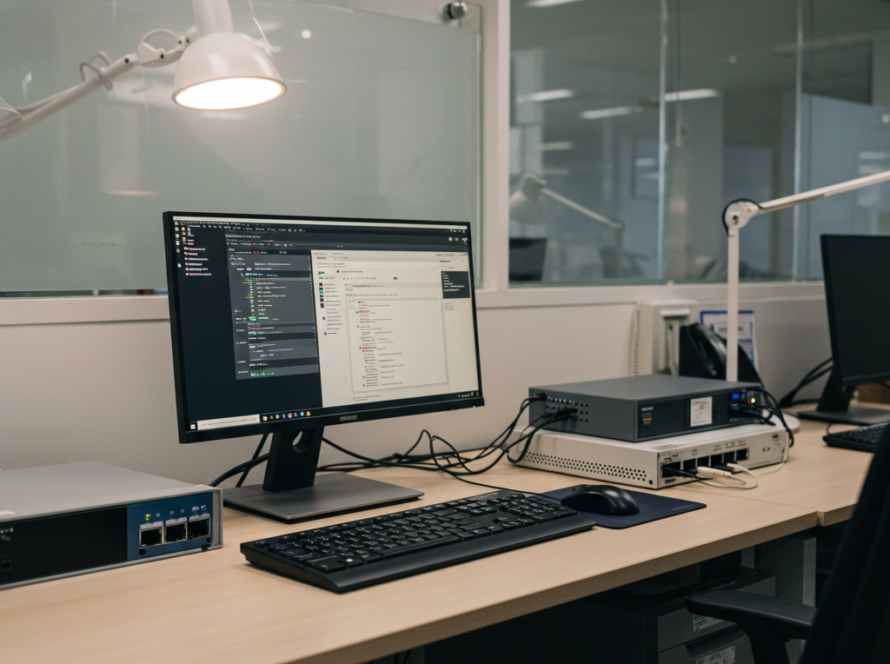
For most Singapore SMEs moving into a new office, the fastest route to a working new office IT setup in Singapore is: a managed switch for the network backbone, one shared multifunction printer, Wi-Fi access points sized to the floor plan, and a basic access control or CCTV setup if the lease requires it. Skip the temptation to over-buy servers or enterprise gear you don’t need yet — most 10-30 person offices run fine on business-grade equipment, not data-centre kit.
We say this because it’s the setup we quote most often. Founders and office managers usually come to us with a lease signed, a move-in date, and no clear idea of what’s actually required versus what a vendor is trying to upsell. This guide walks through the shortlist, the specs that matter, and what to check before you place an order.
What’s the most common new office IT setup in Singapore?
For a typical SME office of 10 to 40 staff, the baseline setup looks like this: a managed switch to segment traffic and VLANs, a shared network printer or copier, structured cabling to each desk cluster, Wi-Fi coverage matched to the floor size, and if the premises need it, door access control and a few IP cameras at entry points and the server room.
Everything else — a dedicated file server, redundant internet lines, a full CCTV grid — is situational. We’d rather tell a client to hold off on a $3,000 server they don’t need yet than sell it because it’s in stock.
Key Takeaways
- Start with network and printing — they’re the two things that stall an office on day one if missing.
- Buy managed switches, not unmanaged ones, if you have more than one department or guest Wi-Fi.
- Rent or buy the printer based on your monthly page volume, not the sticker price.
- Access control and CCTV are lease-driven, not always day-one priorities.
Shortlist: what to buy and who it suits
Here’s how we’d break the shortlist down by office type, based on the jobs we quote regularly through our complete office setup for Singapore SMEs.
| Office Profile | What We’d Recommend | Why |
|---|---|---|
| Small office, under 15 staff, single floor | 8-16 port managed switch, one A4/A3 MFP, 1-2 Wi-Fi access points | Low complexity, fast install, minimal ongoing admin |
| Growing SME, 15-40 staff, multiple departments | 24-port managed switch, VLAN-segmented Wi-Fi, shared high-volume MFP | Needs traffic segmentation and guest network isolation |
| Clinic, school, or regulated premises | Access control at entry points, IP cameras at reception and server room | Often a lease or compliance requirement, not optional |
| Client-facing office (law firm, agency, consultancy) | Kyocera TASKalfa colour MFP, structured cabling, tidy patch panel | Print quality and a clean server room matter for client visits |
If you’re printing more than a few hundred pages a day across departments, a Kyocera TASKalfa earns its keep on running cost. For lighter, single-department printing, a Brother printer for the office is usually the more sensible buy — lower upfront cost, fine for under 1,000 pages a month.
Which specs actually matter — and which don’t?
Buyers often fixate on the wrong numbers. Here’s what we’d tell a client to actually check.
Specs that matter
- Switch port count and PoE budget — undersizing this means you’re buying a second switch within a year.
- Printer cost-per-page (toner running cost) — this is the single most common question we get, and it matters more than the machine’s purchase price over a 3-year period.
- Wi-Fi access point count per floor area — one AP for an open-plan floor of 40 desks is not enough.
- Camera resolution and storage retention — check against IMDA and PDPC guidance on data retention if you’re recording common areas.
Specs that don’t matter as much
- Switch backplane speed rated far beyond your actual traffic (most SMEs never touch it).
- Printer maximum monthly duty cycle — irrelevant unless you’re already printing near that volume.
- Camera brand-name AI features you won’t configure or monitor.
Rent, contract, or buy outright?
This is the second most common question after toner cost. There’s no universal right answer, but here’s our rule of thumb: if you expect to stay in the premises 3+ years and print steadily, buying outright is usually cheaper over time. If you’re on a short lease, unsure of growth, or want the machine serviced without separate call-outs, a contract with bundled toner and service makes more sense.
We invoice on 30-day terms for business accounts, so cash flow timing shouldn’t be the deciding factor either way.
What to check before you order
- Confirm lead time — ready-stock items ship within 1-3 business days, but confirm this against your move-in date, especially for anything made to order.
- Ask who’s doing the physical install. Installation for a typical SME office printer takes 1-2 hours and is quoted per site — factor this into your move-in schedule.
- Check if your new premises already has structured cabling, or if that’s a separate line item.
- Clarify whether support after installation is included or billed separately.
- If you’re setting up security, confirm camera and access control placement against fire exit and door swing regulations before installation day.
For a wider look at what a full office fit-out involves beyond IT — furniture, layout, timelines — our guide on office equipment supply in Singapore is a useful companion read. And if you’re also comparing security hardware, our notes on Hikvision access control and our IP camera buying guide cover the practical side of that decision.
Why work with one supplier for the whole setup?
Coordinating a switch vendor, a printer vendor, a cabling contractor and a CCTV installer separately means chasing four invoices and four lead times for one move-in date. We supply and install network hardware, printers, access control and CCTV as one job, which is usually why SMEs come to Groovit instead of piecing it together themselves. You can browse ready-stock hardware directly on our shop, or read more on how we support SMEs specifically via our IT solutions for Singapore SMEs page.
Speak to Groovit for business IT hardware, setup and support in Singapore. WhatsApp +65 8088 5805 or email [email protected] — tell us your floor size, headcount and move-in date, and we’ll quote the setup, not just the boxes.
Frequently Asked Questions
What's the minimum IT setup for a new small office in Singapore?
A managed switch, one shared multifunction printer, and Wi-Fi access points sized to your floor area cover most 10-15 person offices. Access control and CCTV are added if the lease or business type requires them.
Should I buy or rent an office printer?
If you'll stay in the premises 3+ years and print steadily, buying outright is usually cheaper long-term. Shorter leases or uncertain volume suit a service contract with bundled toner instead.
How long does office printer installation take?
Installation for a typical SME office printer takes 1-2 hours, quoted per site, depending on network setup and whether cabling is already in place.
How fast can I get IT hardware delivered for a new office in Singapore?
Ready-stock items ship within 1-3 business days. Confirm lead time against your move-in date, especially for made-to-order or bulk quantities.
Do I need a managed switch or is an unmanaged switch enough?
If you have more than one department, guest Wi-Fi, or plan to segment traffic with VLANs, a managed switch is worth the extra cost. A single small office with basic needs can often run on unmanaged hardware.